

Tesamorelin is a synthetic analog of endogenous growth hormone-releasing hormone (GHRH) and one of the most clinically documented peptides in the GHRH class. Monthly keyword searches worldwide continue to rise as it has become a focal point for researchers studying the GH/IGF-1 axis, visceral adipose tissue regulation, and metabolic function. This guide covers Tesamorelin’s structure, mechanism of action, key research findings, and what to look for in a verified research supply.
What Is Tesamorelin?
Tesamorelin is a 44-amino acid GHRH analog featuring a trans-3-hexenoic acid modification at the N-terminus. This structural modification significantly increases resistance to dipeptidyl peptidase IV (DPP-IV) degradation — the enzyme responsible for rapid inactivation of native GHRH in circulation. The result is a compound with a substantially extended engagement window at the GHRH receptor compared to endogenous GHRH.
It is the only FDA-approved GHRH analog currently on record, having received approval under the trade name Egrifta for HIV-associated lipodystrophy. This regulatory history makes Tesamorelin particularly valuable to research teams: it carries a Phase III clinical trial dataset that most research peptides lack entirely.
Mechanism of Action
Tesamorelin binds selectively to the growth hormone-releasing hormone receptor (GHRH-R), a G-protein-coupled receptor (GPCR) expressed predominantly on somatotroph cells in the anterior pituitary gland. Upon binding, it initiates intracellular signaling via the adenylate cyclase–cAMP pathway, triggering synthesis and pulsatile secretion of endogenous growth hormone (GH).
This pulsatile GH release follows the physiological downstream cascade:
- GHRH-R activation → pulsatile GH secretion from anterior pituitary
- GH release → hepatic IGF-1 synthesis
- Elevated IGF-1 → anabolic signaling, lipolytic activity, and metabolic modulation
Because Tesamorelin stimulates endogenous GH rather than introducing exogenous growth hormone, GH secretion remains subject to normal physiological feedback mechanisms, including somatostatin inhibition — a key distinction in research modeling compared to direct GH administration.
Key Research Areas
1. Visceral Adipose Tissue (VAT) Reduction
The most extensively documented research application for Tesamorelin is visceral fat reduction. Phase III randomized controlled trials using dual-energy X-ray absorptiometry (DXA) and CT imaging demonstrated reductions in visceral adipose tissue of up to 18% versus placebo. Mechanistically, this is attributed to GH-mediated upregulation of hormone-sensitive lipase (HSL) activity in visceral adipocytes, promoting lipolysis in fat depots that are preferentially responsive to the GH/IGF-1 axis.
2. IGF-1 Axis Modulation
Clinical studies consistently show that Tesamorelin administration produces measurable elevations in serum IGF-1 levels. IGF-1 serves as a reliable biomarker of GH axis activity and mediates many of the downstream anabolic and metabolic effects attributed to GH secretagogues. Research models studying the GH/IGF-1 axis use Tesamorelin as a standardized stimulant for controlled IGF-1 elevation.
3. Lean Mass Preservation
Alongside VAT reduction, clinical trial data documents modest preservation of lean body mass during Tesamorelin treatment cycles. Research in this area focuses on the compound’s potential application in metabolic disease models where muscle wasting and visceral fat accumulation present simultaneously.
4. Cognitive and Neuroprotective Research
Emerging 2025–2026 research is investigating Tesamorelin’s potential role in cognitive function and neurodegenerative marker modulation. The GH/IGF-1 axis has established roles in neuroplasticity and neuroprotection, and it’s ability to reliably stimulate this axis makes it a candidate for studies examining GH deficiency-related cognitive decline models.
What to Look for in Research-Grade Tesamorelin
The quality of Tesamorelin used in laboratory research directly impacts experimental reproducibility. When sourcing for research purposes, the following analytical documentation should be standard:
- HPLC purity verification — confirms compound purity, typically reported at ≥99%
- LC-MS identity confirmation — verifies molecular weight and sequence integrity
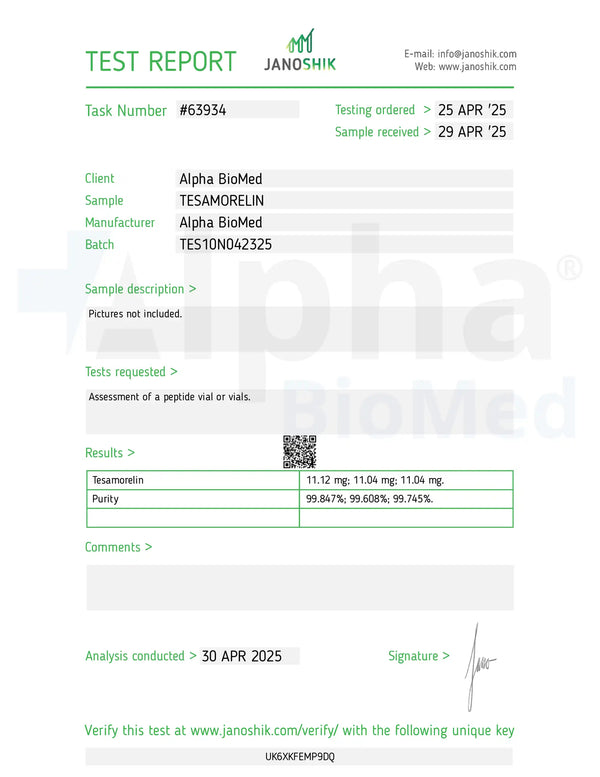
- Certificate of Analysis (CoA) — per-batch documentation covering purity, identity, and QC methodology
- Endotoxin testing — critical for cell-based research models
- Third-party verification — independent lab confirmation eliminates supplier self-reporting bias
At TrueForm BIOLOGx, every batch of Tesamorelin is analyzed via HPLC, LC-MS, NMR, and FTIR before release, with CoAs published in our Transparency Portal. No batch ships without documented verification.
Summary
Tesamorelin stands apart in the GHRH analog class for its clinical trial depth, regulatory history, and mechanistic specificity. For research teams studying GH axis biology, visceral fat metabolism, IGF-1 dynamics, or emerging neuroprotective pathways, it represents one of the most well-characterized tools available.
Sources: Tesamorelin improves fat quality independent of changes in fat quantity – PubMed
Access the full TFBx Tesamorelin product listing, batch CoAs, and analytical documentation at trueformbio.com.
Research Use Only. All TrueForm BIOLOGx compounds are intended strictly for in vitro and laboratory research purposes. Not for human or veterinary use, clinical application, or self-administration.


You must be logged in to post a comment.