For Research Use Only (RUO)
Date of Publication: January 28, 2026
Introduction
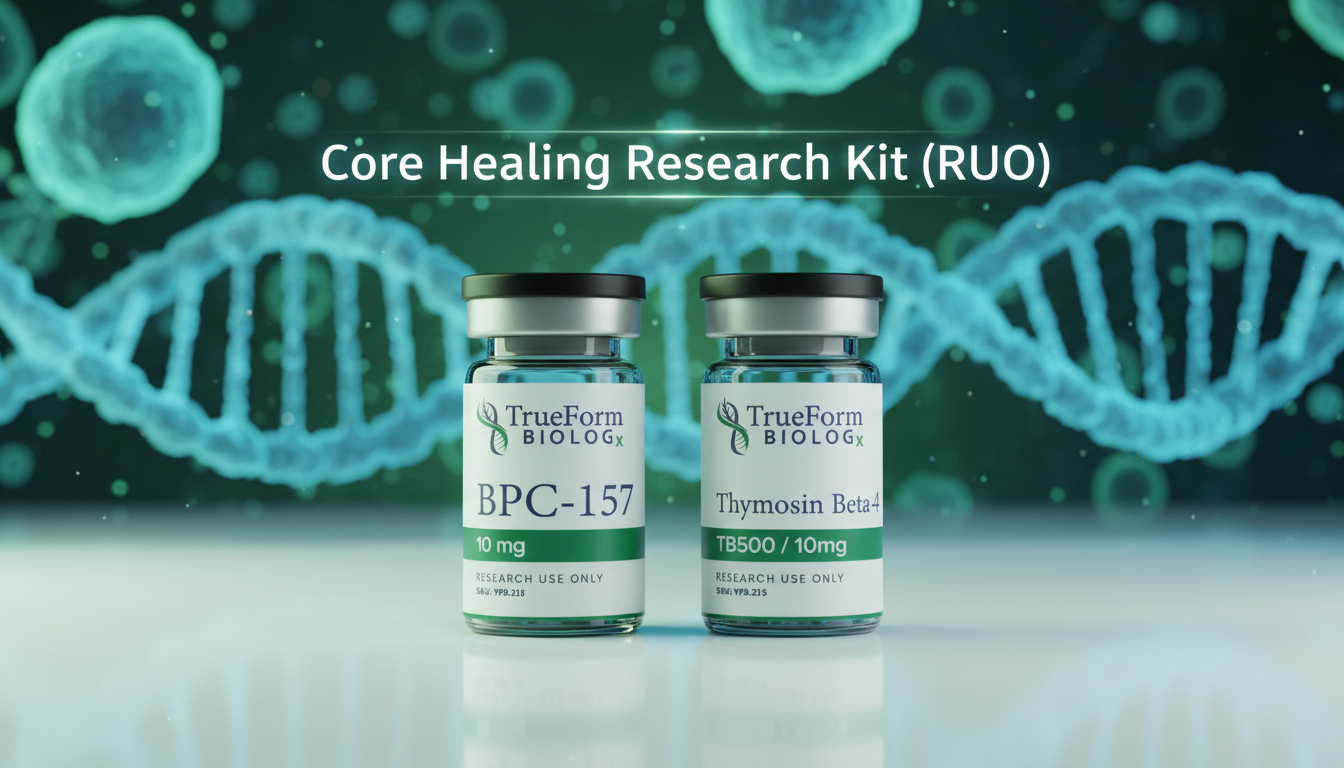
In the rapidly advancing field of regenerative biology, few compounds generate as much scientific interest as BPC 157 and Thymosin Beta 4 (TB‑500).
The TFBx Core Healing Research Kit combines these two well‑characterized research peptides to provide a comprehensive dual pathway platform for investigating tissue repair, angiogenesis, inflammation response, and cellular recovery signaling in controlled laboratory settings.
Both peptides demonstrate distinct yet complementary mechanistic actions that intersect during the tissue regeneration cascade — making the Core Healing Kit a valuable resource for researchers pursuing advanced healing, biocellular therapy, and recovery model studies.
Primary SEO Keywords: BPC‑157, Thymosin Beta‑4, TB‑500, research peptides, healing peptides, tissue regeneration, angiogenesis, wound healing research, research kits, TFBx Core Healing Kit
Component 1: BPC 157 — The Body Protection Peptide
Chemical Nature: Stable pentadecapeptide derived from a gastric protective protein
Research Focus: Studied for its potential in angiogenesis, fibroblast migration, collagen formation, and inflammatory modulation, BPC 157 is a cornerstone compound in many tissue repair and cell signaling models.
Mechanisms of Action (Suggested by Research)
- Regulates VEGF (Vascular Endothelial Growth Factor) pathways to support new vascular development.
- Encourages fibroblast activity and collagen type I synthesis.
- Exerts anti‑inflammatory action by suppressing cytokines like TNF‑α and IL‑6.
- Shows protective potential in gastrointestinal and soft‑tissue oxidative stress research.
Research Benefit: A valuable agent for examining endothelial repair, connective tissue healing, and cytoprotection following mechanical or chemical stress.
Reference: Frontiers in Pharmacology, 2022 – Mechanisms of BPC 157 in Tissue Repair
Component 2: Thymosin Beta 4 (TB‑500) — The Cellular Motility Catalyst
Chemical Nature: A 43‑amino‑acid peptide derived from thymic β‑4 protein
Research Focus: TB‑500 (Thymosin Beta 4) has been widely studied for its role in cell migration, angiogenesis, and cytoskeletal organization — key factors in the regenerative process.
Mechanisms of Action (Suggested by Research)
- Regulates actin polymerization, crucial for cell movement and structural repair.
- Stimulates VEGF and FGF signaling, enhancing vascular and tissue growth.
- Reduces necrotic and inflammatory damage by down‑regulating NF‑κB activity.
- Demonstrated application in dermal, ocular, and cardiac repair research models.
Research Benefit: Ideal for studying cell motility, matrix remodeling, and post‑injury healing phases.
Reference: Nature Reviews Drug Discovery, 2018 – Thymosin Beta 4 in Regenerative Biology
Synergistic Mechanisms — The TFBx Core Healing Model
When BPC 157 and TB‑500 are combined, their multi‑pathway effects create a synergistic environment that mirrors the natural sequence of wound healing — from initial inflammatory response to final tissue restructuring.
| Biological Axis | BPC 157 Activity | TB‑500 Activity | Combined Synergistic Outcome |
|---|---|---|---|
| Angiogenesis | VEGF upregulation creating vascular growth | Endothelial cell migration enhancing capillary networks | Accelerated micro‑capillary formation and tissue oxygenation |
| Fibroblast Migration | Stimulates fibroblast activation | Directs actin remodeling for cell movement | Enhanced matrix realignment and wound contractility |
| Inflammatory Response | Reduces cytokine storms (TNF‑α, IL‑6) | Decreases NF‑κB‑mediated inflammation | Balanced immune‑modulated healing environment |
| Tissue Elasticity & Strength | Increases collagen type I ratio | Improves ECM connectivity | Greater tensile strength in healed tissue models |
Key Research Insights
- Complementary Timelines: BPC 157 initiates early‑phase angiogenic and anti‑inflammatory responses, while TB‑500 supports later‑phase structural and cytoskeletal repair.
- Cooperative Signal Routes: Both act within VEGF and FGF pathways, offering a robust dual system for studying integrated healing mechanisms.
- Localized vs Systemic Action: BPC 157 focuses on localized capillary repair, while TB‑500 extends influence systemically across multiple cell lineages and vascular zones.
Reference: Journal of Biomedical Science, 2021 – Peptide Synergy in Repair and Fibroblast Dynamics
Why Researchers Choose the TFBx Core Healing Research Kit
- Scientifically balanced pairing of two of the most investigated healing peptides.
- Designed for comprehensive tissue regeneration and angiogenic modeling experiments.
- Developed under TrueForm BIOLOGx RUO purity standards (≥ 98 %).
- Ideal for comparative healing studies, fibroblast migration assays, and cellular signaling mapping.
Additional SEO keywords: peptide synergy, regenerative medicine research, healing pathways, TrueForm BIOLOGx peptides, research‑grade BPC 157 TB‑500 kit, trusted peptide supplier.
Conclusion
The TFBx Core Healing Research Kit exemplifies innovation in research‑grade peptide design — combining BPC 157’s angiogenic and protective roles with TB‑500’s motility and repair‑oriented pathways to create a powerful synergistic model for regenerative studies.
Researchers seeking reliable materials for advanced wound healing and tissue repair experiments will find the TFBx Core Healing Kit to be an industry‑leading tool for scientific exploration.
For Laboratory Research Use Only (RUO)
Not intended for human or veterinary application.
Additional Resources and References
- Frontiers in Pharmacology, 2022 – Mechanisms of BPC 157 in Tissue Repair
- Nature Reviews Drug Discovery, 2018 – Thymosin Beta 4 and Repair Mechanisms
- Journal of Biomedical Science, 2021 – Synergy Between Repair Peptides